

Begin here together

This week I'm doing something a little unconventional: posting the entire foreword to my book, Radical Wellness: Pathways to a Healthy Body, Mind, and Planet. There are 3 reasons I am doing so. First of all, I am starting a book club on May 4th! This isn’t a club where hundreds of people are on the call, and the presenter says, “If you agree, throw a heart in the chat.” This is an intimate group of real people doing real sharing, connecting, and growing—limited to just 14 participants. Maybe one of them is you? Are you excited (maybe a little scared?) about the opportunity to read this book slowly and reflectively over 12 weeks? We will meet once a week for an hour to talk about 1-2 chapters, but otherwise the work is up to you. The book is filled with opportunities to journal and exercises to go deeper. The second reason is that I think it is very relevant to what is going on in the world right now. The third reason I am posting the entire foreword is because I am going out of town this week and this is already done. Please visit my website to learn more. www.hilaryconway.com
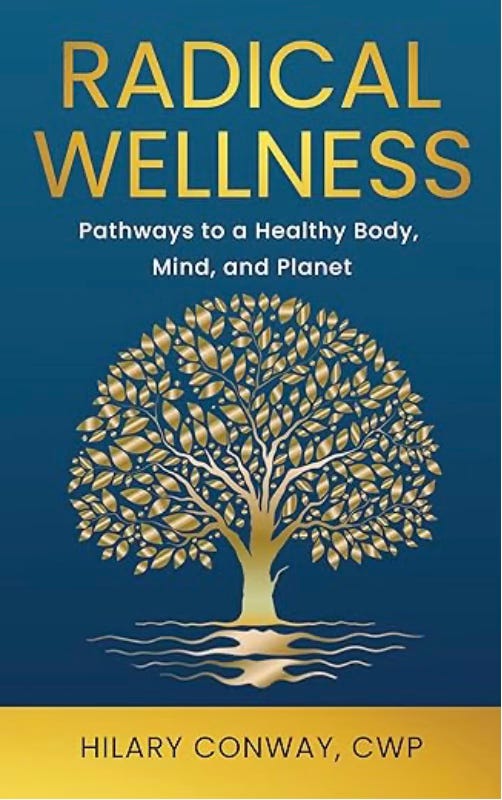
So, here it is . . .
Foreword to Radical Wellness: Pathways to a Healthy Body, Mind, and Planet
My son, when he was 5-years-old, loved dinosaurs. He was obsessed and like a good mom, so was I, for the time being. We watched the Walking With Dinosaurs series until he could recite the lines as he ran through the park pretending to see a Tyrannosaurus Rex lurking behind the trees. We read stacks of books about dinosaurs until their pages curled. He played with little model dinosaurs and drew many, many scenes of dinosaurs in the green, steamy, lush, tropical world of his imagination.
As an adult, I felt pretty lucky that I had been given the opportunity to take such a deep dive into this subject that I really hadn’t given much thought to before. Yes, some days I just wanted to think about what was for dinner instead of being told to be a mommy velociraptor and watch him pretend to crack out of an egg. Kids can sustain this level of immersion and focus, while we must also retain brain space for the basic responsibilities of living.
The dinosaurs lived on Earth for 165 million years and they went extinct about 65 million years ago. One day, they were gone and so was my son’s obsession because his attention turned to sports. The focus shift was much less dramatic than a meteor. But, 165 million years! Such a good run, big guys! Very impressive and I mean that.
In contrast, when the last Ice Age ended and the Earth gradually warmed due to very slow and natural influences, conditions became ideal to sustain life. The planet then entered the Holocene period, a period known for its climatic stability. The Holocene period started about 12,000 years ago and while human remains have been found to date back to approximately 200,000 years ago, civilization, as we know it, began to flourish about 6,000 - 8,000 years ago in the Holocene with the advent of agriculture.
Already it is laughable to compare our time on earth to the age of the dinosaurs and compared to the age of the planet (4.5 billion years), our time here is but a grain of sand on a beach. But, then consider this: In the year 2000, two Nobel prize-winning scientists, Paul Crutzen and Eugene Stoermer, published an article proposing that we were no longer living in the Holocene, that indeed there had been a geological shift, but for the first time ever, this crossing of a geological line in the sand was not from natural causes.
These two scientists named this new epoch the Anthropocene. Anthropos means human beings and the name was chosen to describe when we are living . . . now . . . when modern human activity has had a significant, and maybe even irreversible, impact on the Earth’s climate and ecosystems. This news shook me to my core. I mean, I already knew climate change was real, but had we really started shaping the Earth on a global scale so much so that we needed a new name for the time period? The Earth has survived for literally almost all of its life without us and suddenly we are messing it up?
I have always loved books, especially children’s books and I have had the good fortune to enjoy them as a child, an elementary school teacher, and a mother. Children’s books are beautiful and sad, silly and thoughtful, funny and heart-wrenching, and sometimes all of that in the same book. I remember the first time I read the book Just a Dream by Chris Van Allsburg, who is also famous for his books Jumanji and The Polar Express. It tells the story of Walter, a boy who dreams about the devastating effects of human neglect on the environment, from trash-filled neighborhoods to ancient trees destroyed for trivial purposes. Through vivid and sometimes ironic scenes, like a factory polluting the air while manufacturing remedies for pollution-induced ailments like burning throats and itchy eyes, the book delivers a powerful environmental message that resonates deeply with children.
Or maybe you have read The Wump World by Bill Peet, where the Wumps, peaceful grass-eating animals, lose their home to careless invaders who strip the land of its beauty, leaving behind a barren wasteland. Or I’m sure you have read The Lorax by Dr. Seuss, where the Lorax “speaks for the trees” as the natural world faces the consequences of unchecked greed as all the truffula trees are cut down to make thneeds, that everyone needs. Through whimsical language and colorful characters, the story warns of the cost of exploiting the environment in pursuit of profit.
Maybe you are not a book person. Maybe you have seen the children’s movies Wall-E or FernGully. You get my point. Children’s books and movies have been delivering the message that humans have been having a deleterious impact on the planet for quite some time. These authors and screenwriters have taken a complex emotional subject and made it accessible to children.
And yet, unfortunately, children are not in control of these situations - building factories and chopping down all the trees and such. Children must retain the message of these books and movies until they are older and in power. They have to grow up keeping the message alive and live in accordance with the values they espouse in a society that values money and material things like thneeds. Yes, we have Greta Thunberg and many other amazing people who have grown up to speak out like the Lorax, but they can’t do it without all of us.
“There are times when dreams sustain us more than facts.” I came across these words written by Helen Fagen in a stunningly beautiful and moving book called A Velocity of Being. It is a book of letters written to young readers full of magical artwork and so much raw wisdom. Helen Fagen was a Holocaust survivor who did everything in her power to secretly deliver the salvation of books and the stories they contain to Jewish children in hiding during WWII.
The fact is that Helen and these children were living in a terrifying situation full of real-life monsters. The stories in Helen’s books let these children dream of a different future than the one most of them got. Not all stories have happy endings. But all of the books and movies I mentioned before have hopeful endings. Whether it’s a child inspired to take action, creatures rediscovering a small remnant of their natural world, or a single seed representing the possibility of renewal, each story reminds us that change is possible. These hopeful endings invite us to believe that the effort to heal our world is always worth it.
Helen survived the Holocaust to make sure we knew that there are times indeed when dreams sustain us more than facts. Our ability to hope and dream is ours. It is within us. However, our hopes and dreams cannot be a someday future kind of thing for the next generation to take care of. As Gloria Steinem famously said, “Without leaps of imagination, or dreaming, we lose the excitement of possibilities. Dreaming, after all, is a form of planning.” If we cannot dream up a better world fueled by hope, we will continue to get more of what we’ve got.
More of the same means more plastic waste in our oceans, more carbon warming the atmosphere, and more forests cleared to graze cattle. It means more people living with diseases associated with diet, lifestyle, and environmental toxins. It means more severe weather events such as hurricanes, floods, droughts, heatwaves, and wildfires causing major devastation. Our world is not well. It is up to us to make it better. We can’t move to another planet.
The health of the planet connects back to us. Since we all play an integral role in the wellness of the planet, it is imperative that we start with ourselves. What does it mean to live a “well” and meaningful life? For me, it means that my wellness must take the wellness of other people, living things and the wellness of the planet into account. My wellness is only meaningful in the context of all of LIFE. Each one of us lifts others up when we live with conscious intention. We can choose to hope for a regeneration of both the environment and the human spirit, but we have to choose. We can choose the ending where trees are planted and gardens are grown on rooftops and we eat less animal products and get our power from renewable sources and so much more!
It is an illusion to believe that we are separate from each other and the environment that sustains us. We are made up of trillions of cells and those cells are made up of the same atoms that make up all living things on Earth including the dinosaurs during their time. It is also an illusion to believe that competition is the way forward. We rely on each other and the planet to live. We literally exchange elements with the environment with every breath we take. With each inhale and exhale we interact with nature. Like mycelium under the forest floor that help the entire forest thrive by assisting in the exchange of nutrients between trees, we are all connected. This is all the more reason to pay attention, to choose to show up in the world with intention, an intention grounded in interconnection.
This starts with conscious and unconditional love for ourselves and believing in our worth in the world. None of us are perfect. We are humans, living messy human lives, but we can choose to live and grow with love, compassion, respect, and purpose so that our wellness can ripple out into the world around us. Even the tiniest shifts can change life for the better when we practice them regularly. This is about getting to the root cause of what is ailing us instead of just treating symptoms.
Where do we start? We start here. We accept what got us here and then we set an intention to move forward. When do we start? Now. And now. And now, again. The future arrives as the present so that is where we live. Every moment is a new opportunity. We have a choice.
Scientists have learned so much about dinosaurs and the environment they lived in from their fossil record. What will our fossil record say about us? Will it show that we took all of the resources that the planet had to offer without a thought for regeneration and sustainability? Will it show that we were sick with diseases that weakened our bones. Will it show that we created materials that when thrown away become a permanent record of our time here?
It is time for you to choose to be a VIP - a Very Impactful Person! Every decision you make has an impact on your wellness and the world; smiling at a stranger, holding the door open, giving time, money, advice, and hugs to those in need. Asking for help when you need it allows others to be impactful and lets them know that you value and trust them. The products you choose to buy, the food you eat, the way you listen, the truth you tell, the things you learn, your willingness to try, your ability to grow - are all part of your opportunity to shine your light into the world. You are a VIP, and the more you embody that, the more impact you can have so that you are beaming with joy, love, purpose, and gratitude. This is your life. Even the greedy villain in The Lorax, the Once-ler, came around at the end and realized that the Lorax had been right and implored the boy to help.
“But now,” says the Once-ler,
“Now that you’re here,
The word of the Lorax seems perfectly clear.
UNLESS someone like you cares a whole awful lot,
Nothing is going to get better.
It’s not.
I’m writing this book because I care. I hope you are reading it because you do, too!
Start here now: Why do you care? Why are you reading this book? Why do you get out of bed in the morning? Take a few moments to reflect in your journal - or in the comments.
This crazy world will benefit greatly from us all showing up together. Join the Radical Wellness Book Group and be part of the next chapter.
Much love,
Hilary